Two Eds are Better Than One: Volume Seven
By Ed Hass -
Marlo’s Downjog Separation
Several years ago, my editor and I watched Joshua Jay's DVD Talk About Tricks, a three-volume set based on his column of the same name in Magic Magazine. (A great DVD set!) There is an Oil & Water routine that had a second phase that completely blew us away. Josh had two face-down packets of four cards, ostensibly one of four Jacks, and one of four Aces. He alternated these cards, but didn't show the faces as he did so. Realizing that some people might believe the cards weren't alternating fairly, he turned the packet face-up, and showed the cards quite fairly as alternating. He squared the packet, snapped his fingers and spread the packet again. Now, the Aces were with the Aces and the Jacks with the Jacks. I watched it several times; it looked like either CGI or real magic.
We watched the video a few times more and tried to do what he taught, but neither of us was able to do the sleight properly. Sal spent a few days watching Josh's explanation, until he understood how to do the move. Then he wrote and illustrated the mechanics so the reader could do it too. Within minutes of reading Sal's explanation, I was able to do the sleight well enough to fool my wife.
During the explanation, Josh mentioned that this effect was previously unpublished. Sal investigated further and thought it might be in Marlo's Magazine. It wasn't in Volume 1...or 2. I found it in Vol. 3 as part of a Marlo routine called "Pure Oil and Water." Much to my surprise, Marlo's explanation and Joshua Jay's had some notable differences. First, I'll give Sal's description of what we saw on the DVD. Then I'll write about what Marlo does differently. Finally, I'll throw my two cents in about the differences.
In my last blog post, I was describing Dave Solomon's Oil & Water routine. We were using red and black cards to illustrate the separation of oil and water. In Joshua Jay's version, he uses Aces and Jacks. Sal goes with that as well, explaining why the Aces separate from the Jacks. I suggest you learn the move with the Aces and Jacks as Sal explains it. Once you are comfortable with the move, you can rejoin my explanation of Dave Solomon's Oil & Water---or any routine where you want to show cards alternated and then make them separate.
Sal's explanation of Marlo's Downjog Separation
 This rendition of the Oil & Water routine was developed by Ed Marlo. It was shown to Bill Malone by Marlo, and then shown to Joshua Jay by Bill Malone. It appeared in Malone's and Jay's contributions to the DVD, "World's Greatest Magic by the World's Greatest Magicians" (L & L Publishing, 2010) with very few changes in the handling. Malone described the effect as "one of my favorite Marlo Oil & Water phases of all time" and as "the most visual Oil & Water unmixture procedure that I've ever seen." Jay stated "It's absolutely dynamite! It looks like a camera trick!"
Assume you are holding the following cards in your left hand, face-down, in a squared packet: AS, JC, AD, JH, AC, JS, AH, JD.
Flip the cards, holding them face-up in your left hand, displaying the face-up Ace of Spades.
Perform Marlo's Upjogged Unmixing sleight as follows:
You are holding the alternated eight-card stack, face-up, in your left hand, with the Ace of Spades showing. Tilt your left hand downwards, so that the participant can clearly see the cards.
Lift the Ace of Spades slightly, with your right hand. Then injog it (i.e., towards you) saying "Ace".
As a continuous motion (hands still slightly separated), outjog (i.e., towards the participant) the Jack of Clubs [saying "Jack"] with your left thumb. However, using your left thumb, angle the Jack, and place it to the right (PHOTO 1), clamping it to the Ace with your right thumb, index, and middle fingers. This is a critical point in the sleight, since the Jack of Clubs is the leader Jack (i.e., it sets the height and orientation of the 3 Jacks that will follow), and the Ace and Jack must be positioned correctly. As shown in PHOTO 1, the left edge of the Jack must intersect with about half the length of the top edge of the Ace (A); and the bottom edge of the Jack must intersect with about half the length of the right edge of the Ace (B).
 If the Jack is too far to the left, or too low, the sleight will be difficult, if not impossible.
The hands are no longer separated. At this point, the Jack is resting against the second Ace (Ace of Diamonds). Slide the second Ace downward, angling it towards the left until you hear a click. The click signifies that you have passed Point C (PHOTO 2). Feed the second Ace between the first Ace and the Jack as you are slightly tilting your left hand to prevent you from additionally feeding the second Jack. PHOTO 3 shows the position of the two Aces and Jack from the rear.
Separate hands slightly, and place the second Jack in position.
Continue [injog Ace, outjog Jack, injog Ace, etc.] until all eight cards are in final position. In review of the sequence:
- Slightly separate hands (i.e., lift Ace in right hand)
- Injog Ace of Spades > outjog (angled) Jack
- Slide Ace of Diamonds downward/angled > click > feed
- Lift right hand > outjog 2nd Jack
- Repeat sequence
The final position of the eight cards is shown in PHOTO 4.  Note the following:
- The Aces and the Jacks are oriented in an arc, creating two totally separate fans (unbeknownst to the participant).
- Analogous to PHOTO 1, the upper-left corner of each Jack intersects the Jack that follows it at approximately the middle of that Jack's width.
- Each Ace-Jack pair (Ace of Spades-Jack of Clubs, Ace of Diamonds-Jack of Hearts, Ace of Clubs-Jack of Spades, Ace of Hearts-Jack of Diamonds) shows about the same intersection as in PHOTO 1, Point A.
IMPORTANT: Be careful not to feed the fourth Ace under the first [of Clubs] or second Jack [of Hearts]. This can be avoided by positioning the first three Jacks correctly. PHOTO 5 shows the first three Jacks with the Aces removed. Ideally, the Jacks should pivot on Point D. Then the fourth Ace [of Hearts] can easily be fed under all 3 Jacks without mistakenly feeding it between two Jacks. If any Jack is too high, too low, too far to the left, or too far to the right (i.e., off the pivot point, D), the fourth Ace may be in jeopardy. In fact, the third or fourth Ace can be misfed, but the misfeeding of the fourth Ace is more likely. Another way to avoid misfeeding any Ace is to use your right ring finger to press up the Aces in your right hand while feeding an Ace with your left hand. 
After displaying the cards as in PHOTO 4, quickly close the spread as follows:
Side-to-side: Place your left hand under the cards, palm-up, and squeeze the cards closed, using your left thumb and other 4 left fingers (positioned on the right). This squeezing action is done almost immediately, and in one continuous motion, after the last Jack is placed in its final position. Then:
End-to-end: Place your right hand on top of the cards, palm-down, and squeeze the cards top-to-bottom, using your right thumb (positioned at the bottom) and right middle and ring fingers (positioned at the top).
Then, holding the cards, face-up, in your left hand say:
Let's give them a little time to settle.
Lift the cards with your right hand, turn your left hand, and look at your watch. Wait a few seconds, and then spread the cards in your hands, showing that the Aces and Jacks separated. 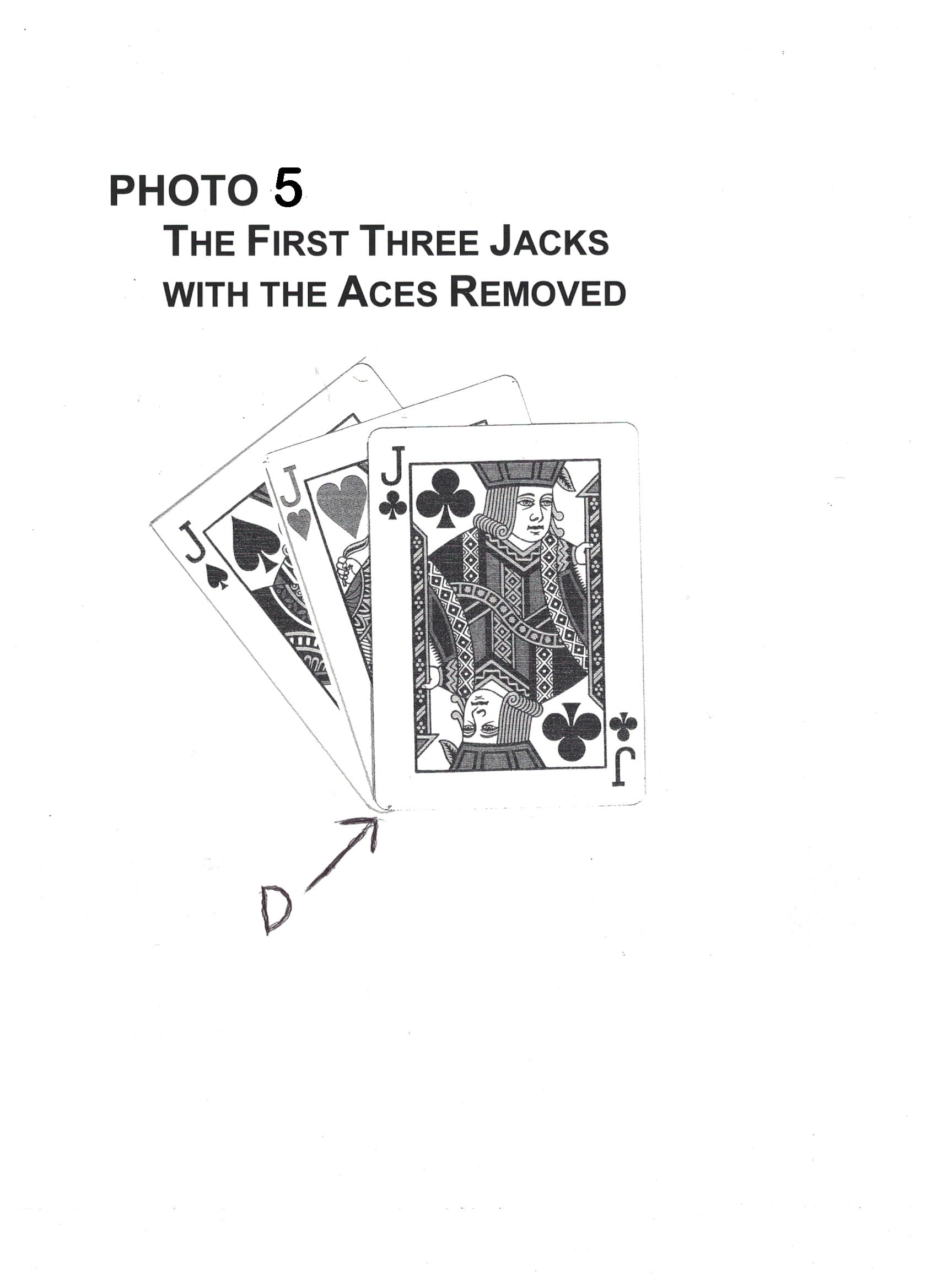
A FEW TIPS:
- As you are injogging the first card, your right thumb should be in the center of the card, or slightly above. This will provide better control, and will allow all of your other 4 fingers (underneath the cards) to remain in contact.
- Once the leader is in position (i.e., the first Jack, see PHOTO 1), as you place the cards ["Ace," "Jack," "Ace," "Jack," ...], be guided by the following (see PHOTO 4):
- The left side of each Jack should be placed close to (or even touch) the large image of the suit [Spades, Diamonds, Clubs, or Hearts] of the Jack that follows it. For example, as shown in PHOTO 4, the left side of the Jack of Hearts is touching the large image of the Spades on the Jack of Spades.
- The Aces should come to a point at their lower-left corner.
- The corner index pips in the upper-left corner of the Aces should be close, i.e., the Ace spread should be tight.
- You want to avoid having the participant hear the click. This would signify that something occurred. Try not to snap the cards during the injogs. It might also help to slightly push up on the cards in your right hand with your right ring finger. However, don't push too hard, since the unmixing sleight may become obvious.
- You might find this helpful. When initiating the final outjog, open your left hand (palm-up, thumb extended) so that the Jacks are resting on your 4 left fingers. This will prevent the final card from dropping down.
What Does Marlo Do Differently?
Marlo starts with the cards alternating black/red from the face to the rear. He upjogs the first card (black). The second is downjogged, with its sides parallel to the first card. The third card is upjogged, a pip's width to the left of the first card. The fourth card (red) is rotated counterclockwise and downjogged so that its lower right corner touches the lower left corner of the first downjogged (red) card. This allows that card to go between the upjogged black card and the previously downjogged red card. The rest of the cards are handled similarly, so the packet will end up as: BRRRRBBB, from the face.
Marlo then squares the sides of the packet, pauses a few beats, and then pushes upjogged and downjogged cards together into his left hand. He now tables the packet, face-up.
Marlo then picks the black card off the face of the packet (showing a red card following it, as expected), and uses it to flip the rest of the tabled cards face-down. He then turns the black card he's holding face-down, and drops it on the tabled packet.
He waits again, and then shows the black cards have all come to the top.
Final Thoughts
I prefer using the Aces and Jacks over red separating from the blacks. Describing that Aces have less ink than Jacks makes the separating a function of the playing cards, which in some offbeat way, seems more logical than the oil and water analogy.
As to which downjog separation? I learned the Jay method, as described by Sal, first; it comes a little easier. I do like the display Marlo gets when he lifts the top card and shows it's a different color, but I don't like the extra handling. I'll just practice it both ways until my intuition leads one way or the other.
Leave a comment
to post a comment.
Similar posts on the blog


Ibidem Table of Contents
Vanishing Inc. Team - 26-Oct-2026
Category: Products
To celebrate the release of the Ibidem ebooks, we've put together the complete table of contents!


Introducing Magic Library Interchange
Andi Gladwin - 22-Aug-2026
Learn about Andi's new proposed web standard for exporting your magic library.


Two Eds are Better Than One: Volume Six
Ed Hass - 19-Aug-2026
Category: About Vanishing Inc.
Ed shares more progress on Marlo's Magazines.


Where Magic Matters Most
Joshua Jay - 14-Aug-2026
Category: ShareMagic
We traveled to Ukraine hoping to give people a brief escape from the realities of war. Performing for children, displaced families, and injured soldiers showed me just how much a few moments of laughter and astonishment can mean.